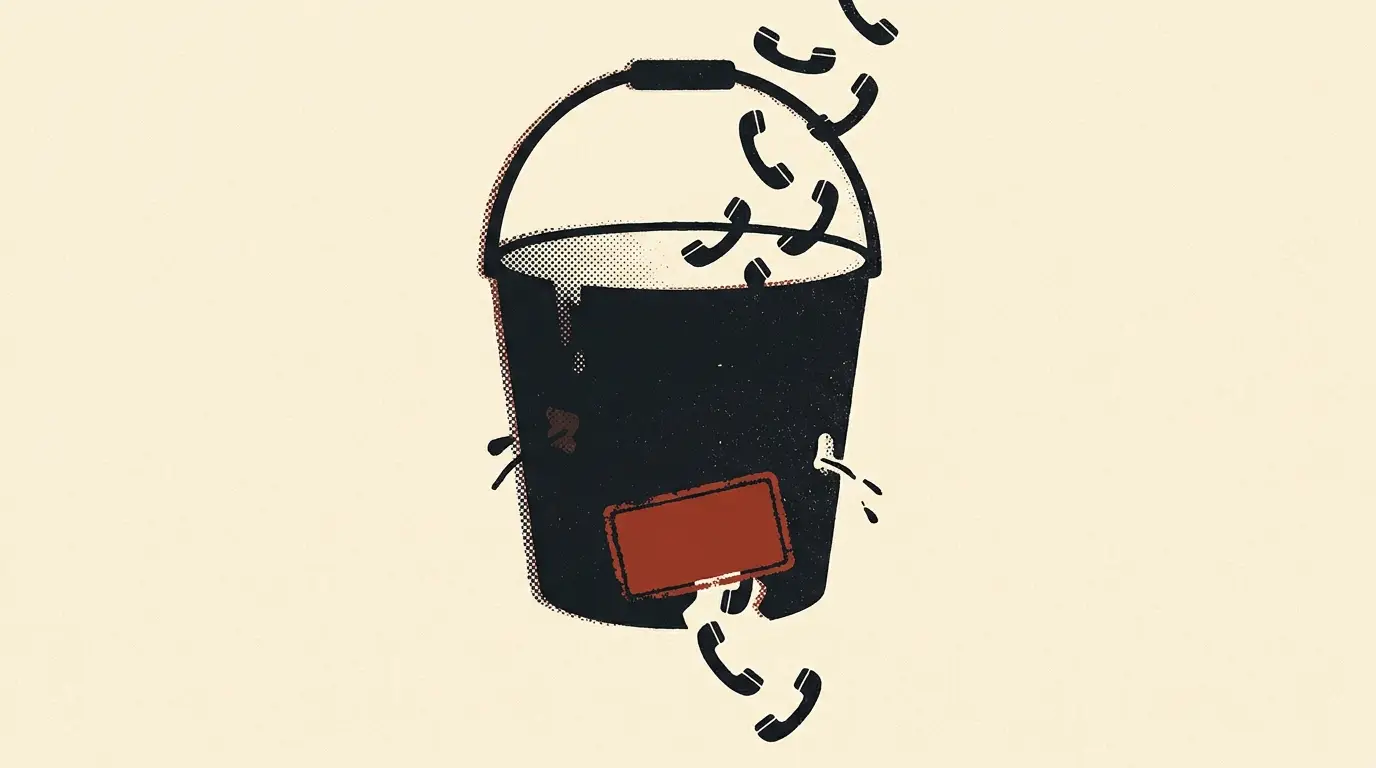
You can win every search result and every AI recommendation, and still lose the customer in the four seconds it takes them to give up on your voicemail.
Visibility brings the lead to your door. Capture is whether you actually let them in. It is the most neglected, highest-ROI part of home service growth, because the leads are already there and already paid for. This is the hub guide to building a capture system that stops the leak.
Capture is the second half of the job
Every marketing dollar you spend buys one thing: a lead reaching out. What happens next decides whether that dollar produced revenue or evaporated. The full path:
- Lead finds you (visibility).
- Lead calls, texts, or fills out a form.
- Someone answers and qualifies.
- The job gets booked.
Steps two through four are capture. If they leak, more visibility just means more leads falling through the same holes. That is why we tell people to fix capture before scaling spend, the logic laid out in why you rank but get no calls.
The three leaks
Leak 1: Unanswered calls. Most home service businesses miss 20 to 40 percent of inbound calls. The crew is on a job, it's after hours, or calls cluster on busy days. Most callers who hit voicemail never call back. They dial the next company. To see what this costs you in real dollars, run the numbers in how much revenue missed calls are costing your business.
Leak 2: Slow follow-up. When a form or text comes in and the response takes hours, the lead has already booked someone faster. Speed is the single biggest lever on booking rate.
Leak 3: Poor qualifying and scheduling. Even answered leads leak if the handoff is clumsy, the questions aren't asked, or booking is a hassle. The lead was real. The process lost it.
The capture system, layer by layer
Layer 1: Answer every call. The goal is zero rings going to a dead end, including after hours and during overflow. That means a system, not hoping someone is free. Your options, compared in detail in AI receptionist vs answering service vs CSR, each have tradeoffs in cost, coverage, and quality. The right one depends on your call volume and ticket size.
Layer 2: Recover every miss automatically. When a call still slips through, an instant text back fires immediately: "Sorry we missed you, how can we help?" That converts a dead-end ring into a live text conversation. Most homeowners will text back. They just won't sit in voicemail.
Layer 3: Respond fast to everything else. Forms, web chat, and texts all decay with time. Automate the instant acknowledgment and route to a human fast. The target is a response measured in seconds, not hours.
Layer 4: Make booking easy. Once you have them, qualify cleanly and book on the spot. Every extra step is a chance to lose them.
Why this beats buying more leads
When calls are low, the instinct is to buy more leads. If your capture leaks, that is the most expensive possible move, because you are paying to generate leads you will fail to convert. Fixing capture is cheaper and faster: you keep the demand you already create. Then, with capture solid, every new lead from visibility actually has a path to revenue.
There is also an attribution payoff. Once you reliably capture leads, you can trace which source produced each booked job, which turns marketing from a gamble into a managed system. That is the subject of closed-loop attribution for home services.
The bottom line
Stop thinking of missed calls as bad luck. They are a structural leak with a known fix. Answer every call, recover every miss instantly, respond in seconds, and make booking easy. Do that and you will book more jobs this month without spending another dollar on marketing.
Rhemic's capture layer answers every call, recovers every miss, and responds instantly, so the leads you already generate stop leaking. See how it works or get a free audit.