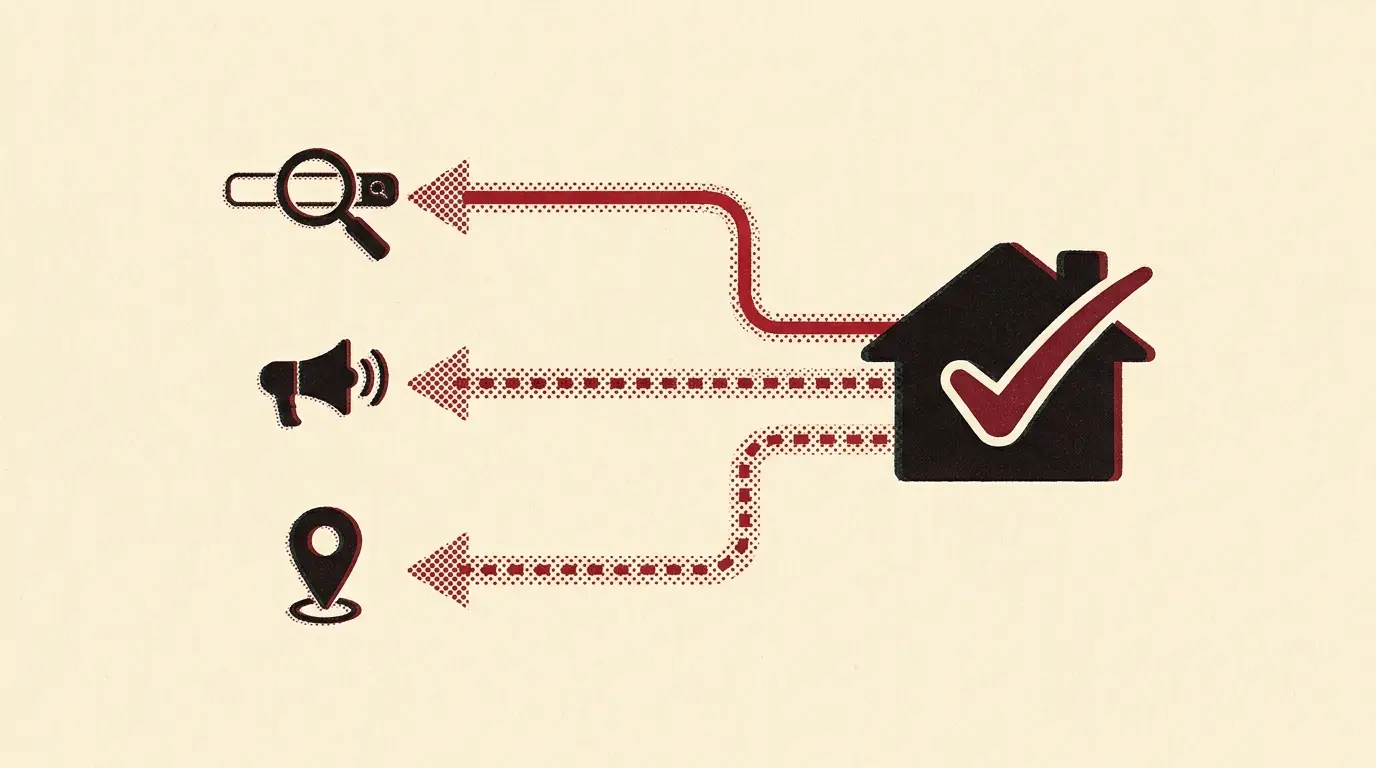
You can't fund what works if you can't see what worked. This is the practical, step-by-step version of connecting each booked job back to SEO, PPC, or LSA, so your budget follows revenue instead of hunches.
The goal: every job has a source
The end state is simple. For every booked job, you can say which channel produced it: organic search, Google Ads (PPC), Local Services Ads, your map listing, or a referral. Once that's true, budgeting stops being a debate and becomes arithmetic. This is the applied version of closed-loop attribution for home services.
Step 1: Make every lead carry its source
Leads arrive by phone and form. Tag both:
- Calls: use source-aware call tracking. A distinct number (or proper dynamic number insertion on the website) for organic, PPC, and your map listing, so each call's origin is known. The how-to is in call tracking for home services.
- Forms and chat: capture UTM parameters and the landing page so the submission records where it came from.
- LSA: Google's Local Services Ads report their own leads separately, keep that stream distinct so it doesn't get lumped with PPC.
The principle: no lead enters your pipeline without an origin attached.
Step 2: Record the outcome
A source without an outcome is half a measurement. In your CRM, scheduling tool, or a disciplined spreadsheet, every lead needs:
- Whether it booked.
- The job value.
- The source (carried from step 1).
If your team books jobs by phone, add one habit: confirm or log the source at booking. That single field is what makes the whole thing work.
Step 3: Connect source to outcome
Now join them. Each booked job, tagged with its source and value, rolls up by channel:
- Total booked jobs per channel.
- Total revenue per channel.
- Spend per channel.
From there you get the only numbers that matter: cost per booked job and revenue per channel. That's the metric reframe in cost per booked job vs cost per lead.
Step 4: Keep PPC, SEO, and LSA honest
The common failure is letting channels steal each other's credit. A few rules:
- Distinct tracking per channel so attribution is clean.
- Don't let last-click bury the assist, a homeowner may find you in an AI answer, then click an ad, then call. Note multi-touch where you can.
- Review monthly, not daily. Home service sales cycles and seasonality need a few weeks to read clearly.
Step 5: Reallocate
With clean numbers, act. Move budget from high-cost-per-booked-job channels to low ones. Cut what doesn't book. Scale what does. This is where attribution pays for itself, often many times over, because most businesses are funding at least one channel that looks busy and books little.
The bottom line
Tracking jobs back to SEO, PPC, and LSA is three steps: tag every lead's source, record every outcome, and connect them. Do it and your marketing budget finally follows revenue instead of guesses.
Rhemic connects every lead's source to the booked job, so you see exactly what each channel produced. See how it works or get a free audit.